Designing with FRP pultruded profiles
FRP profiles do not rust, do not conduct and weigh a quarter of steel, but they are not steel. The habits that make an FRP structure stiff, safe and economical.
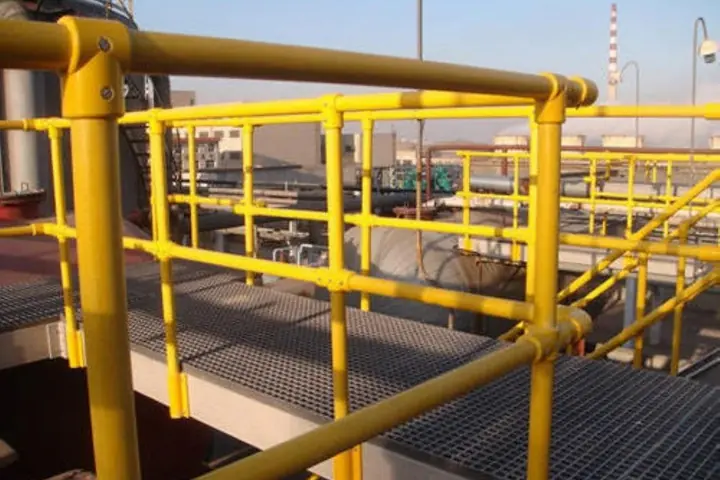
Around pickling tanks, scrubbers and effluent plants, painted steel is in a fight it slowly loses. FRP pultruded profiles do not rust, do not conduct electricity and weigh about a quarter as much, so a walkway or cable tray made from them outlasts steel many times over in acid service. But FRP is not steel with better paint. Design with its own rules and it serves for decades; design as if it were steel and it disappoints.
Design for stiffness, not strength
Pultruded glass-fibre profiles are strong, but their stiffness is roughly a tenth of steel. In practice a beam or a grating is sized by how much it may bend, not by what breaks it. So think deflection first: choose a deeper section rather than a thicker one, shorten spans, and use the maker’s span tables rather than steel tables. Strength then usually looks after itself.
Direction matters
Pultrusion pulls all the main fibres along the length of the profile, which is why it is so strong that way. Across the fibres it is much weaker, and that changes the details:
- Bolt, do not weld. Joints use gussets and cleats, with stainless or FRP bolts in acid areas.
- Spread every bolt load with large washers, and do not overtighten: crushing the section is the usual site mistake.
- Keep bolt holes back from cut ends, and support both flanges of a beam at its bearings.
Choose the resin for the chemistry
The glass gives strength; the resin fights the chemicals. Isophthalic polyester profiles handle most plant atmospheres and dilute acids. For hot or concentrated acid, chlorine and hypochlorite service, vinyl ester earns its extra cost. Outdoors, a surface veil and pigmented resin keep ultraviolet light from fuzzing the surface.
Temperature and fire
Standard profiles are comfortable at normal plant temperatures; sustained heat well above that calls for the resin maker’s data, and ducting hot gas is its own subject. Where escape routes and cable trays need it, fire-retardant resin grades are available: say so when ordering, not after.
Site habits that pay
- Drill, never punch, and use sharp carbide tools; blunt tools splinter the surface.
- Seal every cut end and drilled hole with resin, so moisture and acid cannot wick along the fibres.
- Store profiles supported along their length; a long profile left on two points takes a set.
Where to use it first
The quickest wins are the places steel suffers most: gratings, walkways and handrails over pickling and effluent tanks, cable trays and ladders in acid and electrical areas, and supports beside scrubbers. SHIVAS Products India makes the pultruded profiles and resins; SHIVAS Reinplast builds the gratings, handrails and FRP fabrication around them.