Better for straightening, spring and high-carbon wire.
SHIVAS Technology · Wire drawing
Straight line wire drawing machine
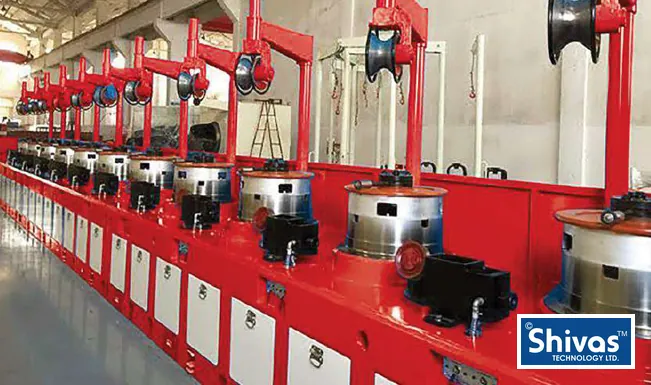
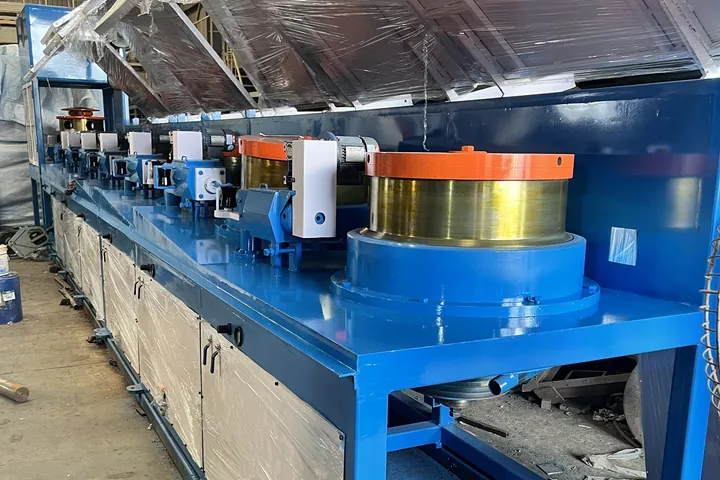
Flagship · SLM-600Straight line wire drawing machines: wire runs straight from block to block, with no twist, for MS, HB, high-carbon and spring wire.
- Individual AC drives
- Dancer tension control
- Water-cooled blocks
- Rotating die boxes
 9 photos
No twistwire passes straight through every block
Speed syncdancer-free control by drive
Water-cooled blocksheat out of wire and die
Overview
In a straight line machine each block pulls the wire through its die and passes it straight to the next die, without the wire looping over the top. Every block has its own motor and drive, and the drives keep the blocks in step as the wire elongates through each die, so the wire is never twisted or slack.
SHIVAS straight line machines are built for steady, high-output drawing: rigid fabricated frames, hardened capstans, water-cooled blocks and die boxes, and a control system that ramps all blocks together. The number of blocks follows from rod size, finished size and the reduction per pass we design with you.
Why it pays
Each block driven and cooled for continuous running.
Die sequence designed for even work in every block.
Wide access and pointing at each block.
Technical specification
Typical ranges. Every unit is sized to your duty; the offer carries the exact figures.
| Blocks | Typically 4 to 12 |
|---|---|
| Capstan diameter | Chosen for wire size, commonly 400 to 900 mm |
| Inlet rod | Commonly 5.5 to 12 mm |
| Finished wire | Down to about 1 mm, depending on blocks |
| Drives | AC motors with VFDs, synchronised |
| Cooling | Water-cooled capstans and die boxes |
| Die boxes | Fixed or rotating, pressure dies on request |
Calculator
Work it out for your own plant. Every input is a typical value you can change and the results follow as you type; send the result to us and we reply with a proposal.
How it works
Straight line wire drawing machine
Watch it run →Wire runs from block to block in a straight line, with no twist. The blocks are inclined: the wire leaves the top of each block over a dancer roller and goes straight down into the die box of the next block. The dancer senses wire tension and the PLC trims each block’s AC drive to hold it steady. At every die the wire gets thinner and faster.
Main parts
- 1PayoffRod coil feeds the line.
- 2Die boxRotating die box with drawing soap before every block; the die sizes the wire.
- 3Inclined drawing blockWater-cooled capstan set at an angle; the wire enters at the foot, wraps a few turns and leaves at the top.
- 4Dancer armRoller on a sprung arm between blocks; it rises and falls with tension and tells the PLC to trim block speed.
- 5Motor and gearboxAC inverter drive for each block.
- 6Finished wireOut to the dead block coiler or spooler.
At a glance
- Blocks
- 6 to 9 · Ø 600 mm on SLM-600
- Drive
- AC inverter per block, PLC
- Capstans
- Inclined, water-cooled
- Tension
- Dancer arm between blocks
Options, build and uses
Options
- Rotating die boxes
- Pressure die holders
- Soap feeders and stirrers
- Payoff, descaler, pointing and coiler as one line
How we build it
- Frames, guards and die boxes fabricated in our shop
- Gearboxes, motors and drives from established makers
Who it is for
- MS and HB wire
- High-carbon and spring wire
- Galvanizing feed wire
- Binding wire
Part of
3D model
Computer model from a real SHIVAS project. It shows the arrangement; it is not a photo.
From our engineers
Questions buyers ask
Straight line or OTO?
Straight line for high-carbon and quality wire with no twist; OTO for flexibility and lower cost on low-carbon wire. Our blog article compares them.
How many blocks?
Total reduction divided by a sensible reduction per pass; we design the die sequence with you.
Enquiry · Straight line wire drawing machine
Get a quote
Tell us the capacity, sizes and site. We reply with a scheme, a layout and an offer.
What we need for your quote
- Rod size and grade
- Finished size range
- Output wanted (t/day)
- Take-up type