Straight line or OTO? Choosing a wire drawing machine
Both machines pull wire through a series of dies. The difference is what happens between the blocks, and it matters for the wire you sell.
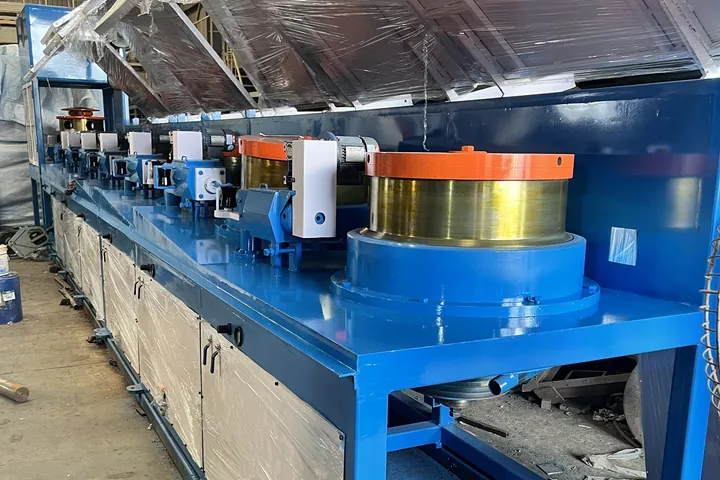
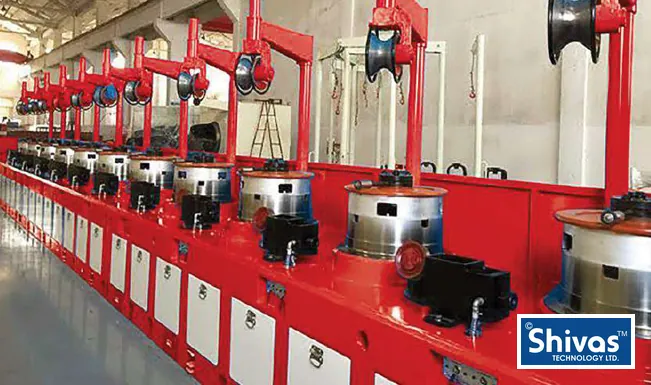
A multi-block dry drawing machine reduces rod to wire through a series of dies, each followed by a driven block, or capstan, that pulls the wire through. Straight line and over-the-top (OTO) machines both do this. They differ in how the wire travels from one block to the next.
Straight line
In a straight line machine the wire leaves each block and runs straight into the next die. Nothing is stored between blocks, so every block must run at exactly the speed that matches the elongation in its die. Modern drives and sensing keep the blocks in step.
- No twist: the wire is never turned over the top of a block.
- Suits high-carbon, spring and quality wire, and wire that will be straightened later.
- Higher speeds and better cooling are possible.
- Needs good drive control and correct die sequence.
Over the top
In an OTO machine the wire is stored as turns on each block and leaves over the top, through a guide pulley, to the next die. The stored turns act as a buffer, so the blocks do not have to be precisely matched.
- Forgiving of speed differences and die wear.
- Simpler control and lower cost.
- Each turn over the top adds a twist to the wire.
- Well suited to low-carbon wire: binding, nail and MS wire.
| Feature | Straight line | OTO |
|---|---|---|
| Twist in wire | None | Some |
| Control | Synchronised drives | Accumulation |
| Best for | High-carbon, spring, quality wire | Low-carbon, general wire |
| Cost | Higher | Lower |
The die sequence matters as much as the machine
Whichever machine you choose, output and wire quality depend on the reduction in each die and the die angle. Too little reduction wastes blocks; too much breaks wire and burns dies. We design the die sequence for your rod and finished sizes, and our die designer on the wire drawing page shows how die angle and reduction interact.