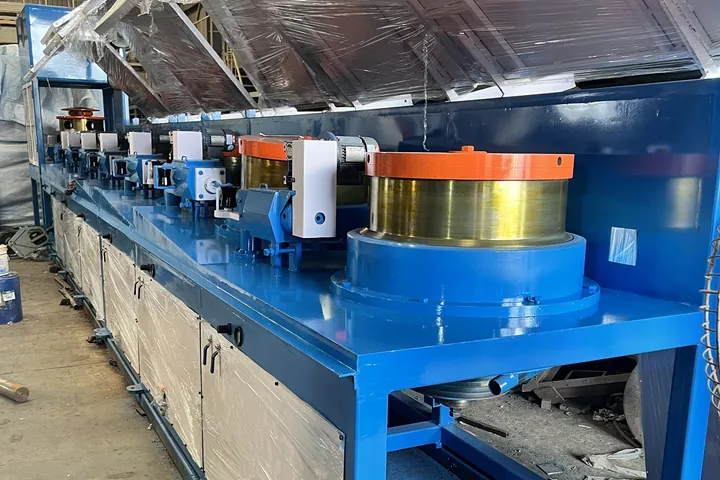
Wire drawing lubricants: dry soaps and wet drawing
The die does the work, but the lubricant decides how long it lives. How to choose and run dry soaps and wet lubricants on a drawing line.
A drawing die does its work in a film of lubricant a few microns thick. While that film holds, the die polishes the wire and draws tonne after tonne. When it breaks down, the die scores, the wire scratches and heats, and every pass downstream pays for it.
Dry drawing
Rod and coarse wire are normally drawn dry, through a box of soap powder bolted ahead of each die. Calcium soaps are tough and carry the heaviest work; sodium soaps are cleaner and wash off easily. Many mills run calcium soap on the first passes and sodium soap on the last, so the finished wire is easier to clean.
Soap can only work if the wire carries it into the die. That is what the carrier coating after pickling is for: lime, borax or phosphate, dried onto the rod, holds the powder and drags it into the die throat. A rod that was rinsed poorly or coated unevenly draws badly, whatever the soap.
- Keep soap dry. Damp soap cakes, stops flowing and starves the die.
- Stir the boxes and top them up on a schedule, not when the wire starts to squeal.
- Cool the dies. Soap chars when the die runs too hot, and charred soap no longer lubricates.
- Match the soap to the pass: coarser grades on the first dies, finer grades as the wire gets thinner.
Wet drawing
Fine wire, and any product that needs a bright surface, is drawn wet: dies and blocks run flooded in an emulsion or oil. A wet bath is a living thing, and it is managed, not just topped up.
- Check concentration with a refractometer every shift. A thin emulsion scratches; an over-rich one foams and wastes money.
- Hold the bath temperature steady with a cooler. A hot bath splits and smells; a cold one drags.
- Filter or settle out the metal fines. Fines in the bath act like grinding paste in the die.
- A sour smell after a weekend means bacteria are eating the emulsion. Treat it or dump it before it ruins the wire.
What failing lubrication looks like
- Long scratches down the wire: the film broke, or metal has picked up on the die.
- Straw or blue colour on the wire off the block: overheating, from speed, cooling or starved soap.
- Chatter marks across the wire: vibration from a worn or badly seated die.
- A wear ring at the die entry: normal wear, but recut the die before the ring collapses into the bearing.
Think past the die
Whatever the lubricant does for the die, its residue goes on to the next process. Heavy calcium soap residue survives ordinary cleaning and shows up as bare patches on galvanized wire; hygroscopic carriers pull in moisture and rust the coil in the store. If the wire will be annealed, galvanized or plated, choose the lubricant with the end of the line in mind, and clean accordingly.