High-velocity burners and kettle life: heat the wall evenly, not harder
A kettle rarely dies of old age. It dies where one patch of wall ran hotter than the rest. How burner type, placement and control decide how long a kettle lasts.
Molten zinc dissolves steel. It does so slowly at the bath temperature, and much faster when the steel is hotter. A galvanizing kettle is a steel box full of zinc, heated through its own walls, so the inner face of the wall is always the hottest steel in contact with the zinc. Keep that face below about 480 °C everywhere and a kettle lasts for years; let one zone run hotter and the wall thins there first, the zinc picks up the iron as dross, and the kettle is changed early.
Heat flux is the number that matters
The furnace has to push heat through the wall into the zinc: enough to heat the steel being dipped, melt the zinc it carries away, and cover the losses from the bath surface and the casing. Spread that heat over the whole heated wall and the wall stays only a little hotter than the zinc. Concentrate it and the wall overheats locally. That is why we size a furnace on heat flux, the heat per square metre of wall, and keep it below about 18 to 20 kW/m² for a steel kettle.
| Design choice | Effect on the wall |
|---|---|
| Longer or deeper kettle | More wall area, lower heat flux for the same output |
| Higher throughput per hour | More heat needed, higher heat flux |
| Burners firing along the wall | Heat spread over the length |
| Flame touching the wall | Hot spot: the wall thins there first |
Why high-velocity burners
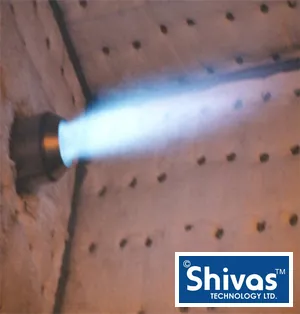
A high-velocity burner completes combustion inside its own refractory chamber and leaves through a nozzle at high speed, often around 100 m/s. That jet does not heat the wall directly. It drives the hot gases round the furnace chamber so they sweep the whole kettle wall at a fairly even temperature. A slow, lazy flame does the opposite: hot at the point where it burns, cooler everywhere else.
For the same reason, high-velocity burners are usually pulse-fired at low load. Instead of turning the flame down, which slows the jet and loses the stirring, the burner fires at full rate in short pulses. The average heat input falls while the gas velocity, and so the evenness of heating, stays high.
How many burners, and where
- Short kettles, up to about 8.5 m, are usually heated by two burners, one at each end, firing in opposite directions along the two long walls.
- Kettles up to about 13 m usually have four, and longer kettles six, so no part of the wall is far from a burner jet.
- Burners fire tangentially along the wall and never at it. Baffles and the furnace shape keep the jet off the steel.
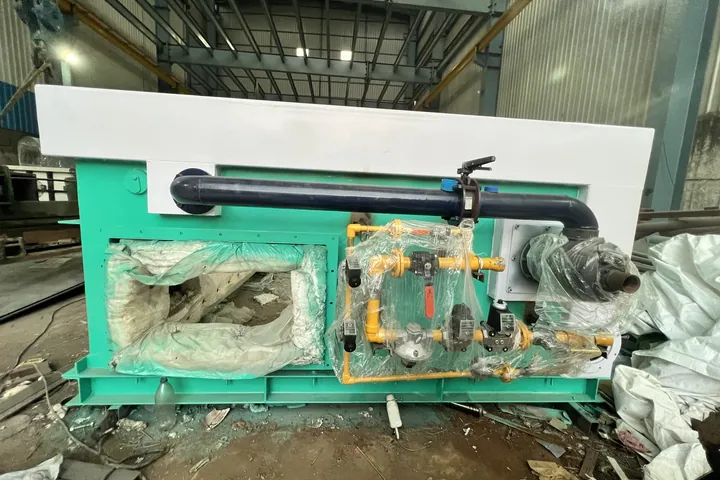
- Each burner has its own flame supervision, and gas trains with double shut-off valves and proving, so a failed burner cannot fill the chamber with gas.
Measure the wall, not only the zinc
Most plants control on the zinc temperature, which is right for coating quality. But the zinc can be at 450 °C while one panel of wall is far hotter. Thermocouples on the outside of the kettle wall, along its length and at more than one depth, show the wall profile. The control system can then limit firing when any wall reading climbs, and the log shows which zone is working hardest. A rising trend on one thermocouple is the earliest warning of a kettle problem.
Available heat and fuel
Only part of the fuel's heat stays in the furnace; the rest leaves in the flue gas. With cold combustion air and sensible excess air, a galvanizing furnace typically keeps around 45 per cent of the fuel's heat. Pre-heating the combustion air in a recuperator raises that, and so does keeping excess air under control. Sending the flue gas on to the dryer uses some of what is left.
A checklist for an existing furnace
- Find the wall heat flux at your highest production rate. If it is above about 20 kW/m², production is costing kettle life.
- Look for flame or hot-gas impingement: discoloured refractory or a hot patch on the kettle wall opposite a burner.
- Fit wall thermocouples if you do not have them, and log them with the zinc temperature.
- Check that burners turn down by pulsing, not by running lazy flames.
- Check excess air and the condition of the recuperator, if fitted.