PP, PP-H, PVDF or FRP: choosing the material for a process tank
Polypropylene, PVDF and FRP each have their place in acid service. How temperature, chemicals, size and support decide the material, and how DVS 2205 helps.
Steel tanks lined with rubber or brick were the old answer to acid. Thermoplastic and FRP tanks have largely replaced them in pickling, plating and chemical plants: they do not corrode in hydrochloric or sulphuric acid, they are light, and they are built by welding and laminating instead of lining. But plastics creep under a constant load and lose strength as they get warmer, and a tank designed as if it were steel will bow, crack at its welds, or fail early.
The candidates
- PP-H, homopolymer polypropylene. Stiffer and stronger than the copolymers, and good at higher temperatures. The usual choice for pickling, degreasing and flux tanks.
- PP copolymers. Tougher at low temperatures and under impact, a little less stiff.
- PE-HD, high-density polyethylene. Excellent chemical resistance and toughness, but softer than PP and limited to lower temperatures. Common for storage at ambient temperature.
- PVDF. A fluoropolymer for higher temperatures and for strong oxidising chemicals that polypropylene cannot take. It costs much more, so it is often used as a thin liner.
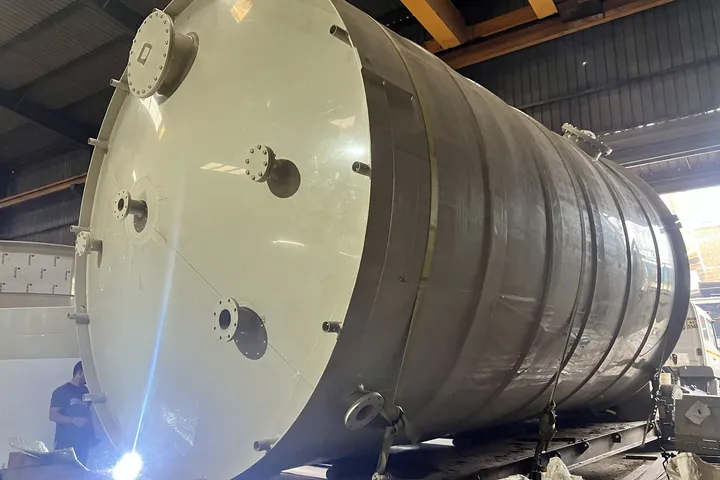
- FRP. Glass fibre in a resin such as vinyl ester or isophthalic polyester. Strong and stiff, it suits large tanks and higher temperatures. Its chemical resistance comes from a resin-rich inner layer reinforced with a surface veil.
- Dual laminate. A thermoplastic liner of PP or PVDF, welded tight, inside an FRP structure: the chemical resistance of the plastic with the strength of the FRP.
Temperature and time
A plastic's long-term strength falls as the temperature rises, and every chemical makes it fall a little further. DVS 2205, the German guideline used across the industry, sizes a thermoplastic tank from the creep strength of the material at the design temperature over the design life, reduced by factors for the chemical, the welds and the toughness of the material. A tank that is fine at 30 °C may need much thicker walls, or a different material, at 70 °C. Always give the tank maker the highest temperature the tank will ever see, not the usual one.
Size, shape and support
- Round tanks carry the liquid pressure as hoop tension and need far less wall than rectangular ones of the same volume.
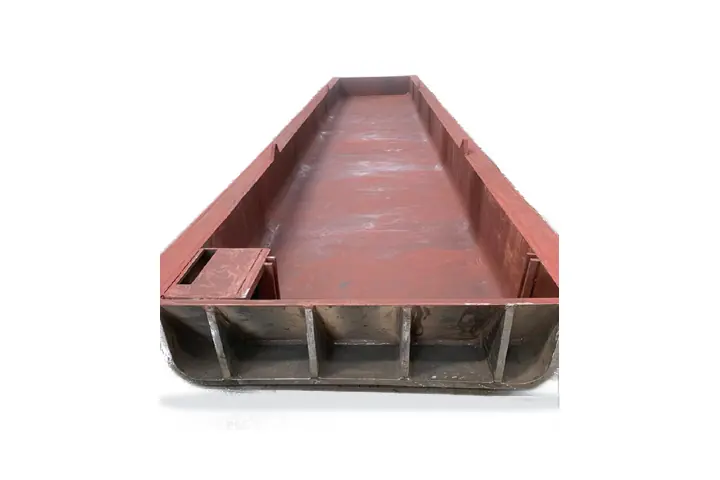
- Large rectangular tanks need stiffening, with plastic ribs or a steel frame outside the tank, or their walls slowly bow over the months.
- The floor must be flat and fully supported. A plastic floor bridging a gap creeps into it.
- Heating coils, agitators and hoods add point loads and heat that the design must allow for.
Chemistry
| Service | Common choice | Watch for |
|---|---|---|
| Hydrochloric acid pickling, ambient to warm | PP-H | Stiffening on long tanks; fume capture |
| Sulphuric acid pickling, heated | PP-H, or FRP with a suitable liner | Temperature against long-term strength |
| Alkaline degreasing, hot | PP-H | Temperature; insulation saves heat |
| Flux, zinc ammonium chloride, warm | PP-H | Temperature |
| Chromic and strong oxidising acids | PVDF, or PVDF-lined FRP | Polypropylene is attacked |
| Large storage at ambient temperature | PE-HD, PP or FRP | Round tanks where space allows |
| Fume ducts and scrubbers | PP or FRP | The temperature of the gas |
Resistance depends on concentration and temperature together. Check every chemical, including cleaning chemicals and anything that may be added later, against resistance data at the real conditions.
Welding and testing
Thermoplastic tanks are joined by hot gas welding, extrusion welding and butt fusion, and a weld is weaker than the sheet, which the design factors allow for. Good tanks are built by trained welders to written procedures, welds are spark-tested for porosity where it matters, and the finished tank is filled with water and watched before any chemical goes in.
What to tell the tank maker
- Every chemical, its concentration and the highest temperature.
- Inside dimensions, working level and volume.
- Fittings: heating coils, agitators, hoods, nozzles and level instruments.
- How it will be supported, indoors or outdoors, and the design life.