When the shed still smells of acid: troubleshooting a fume scrubber
Fume at the tanks, a sour smell and rusting steel from a scrubber that is installed but not working. Where to look, in order: capture, ducts, packing and fan.
A fume scrubber that is installed but not working gives itself away slowly: a sour smell in the shed, fume drifting off the pickling tanks, crane rails and roof sheets rusting, and complaints from the neighbours. The cause can be anywhere along the air path. The quickest way to find it is to follow the air from the tank to the stack and measure at each step.
1. Is the fume reaching the hood?
- Hold a smoke tube at the edge of the tank. The smoke should bend firmly into the slots; if it drifts, the capture is too weak there.
- Measure the air velocity at the slots with an anemometer and compare it with the design. Capture needs roughly 0.25 m³/s per m² of tank surface for push-pull, and around 0.4 for a lateral slot.
- Look for blocked slots, dampers left closed, damaged hoods, and draughts from doors and fans that blow the fume away from the hood.
- On push-pull hoods, check that the push jet is clear and aimed along the surface.
2. Is the air getting to the scrubber?
- Read the static pressure along the duct. A big drop between two points means a blockage there.
- Look for leaks and holes: air drawn in at a leak is air not drawn from the tanks.
- Check low points for condensate. Ducts carrying wet, acid air need drain points.
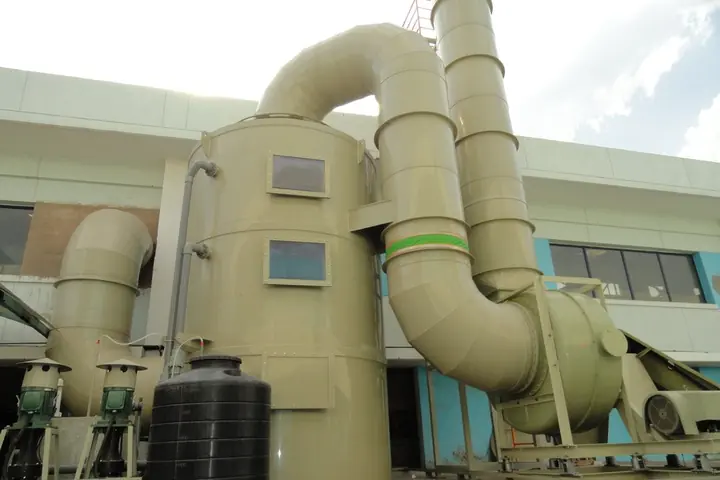
3. Is the scrubber washing the air?
- Liquid flow. Pump running, flow at design, spray nozzles clear. A blocked nozzle leaves dry packing, and acid passes straight through.
- Pressure drop across the packing. Rising: fouling, scaling with iron or calcium salts, or flooding from too much liquid. Falling: packing collapsed, or the air bypassing it.
- Liquor strength. Water scrubbing HCl grows more acidic as it works. If the bleed is too small, the liquor becomes strong enough to give HCl back to the air. Measure pH and density, and keep a steady bleed with fresh make-up. With a caustic polishing stage, hold its pH set point.
4. Is mist leaving the stack?
A damaged or blocked mist eliminator lets droplets of acid liquor out of the stack. The signs are acid spotting and corrosion on roofs and vehicles near the stack, and a wet plume. Inspect and wash the eliminator, and replace damaged sections.
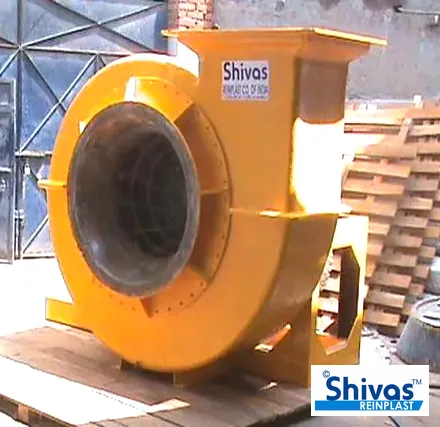
5. Is the fan moving enough air?
- Check the direction of rotation, especially after any electrical work. A centrifugal fan running backwards still moves some air, but only a fraction of its rating.
- Check belt tension and slip, the impeller for damage or build-up, the damper position and the drive speed.
- Compare the motor current with its rating, and measure the air flow with a pitot traverse in a straight run of duct.
6. Is the stack right?
Check the stack height and the sampling ports your consent conditions require, and test the emission at the stack. A result just inside the limit with the plant at half load will not be inside it at full load.
| Symptom | Most likely | Check | Fix |
|---|---|---|---|
| Fume at one tank only | Local capture | Smoke test, slot velocity | Clear slots, balance dampers, shield draughts |
| Fume at every tank | Too little air overall | Fan rotation, current, flow | Fan speed, belts, impeller, duct leaks |
| Sour smell at the stack | Liquor saturated, or dry packing | pH, density, liquid flow | Bleed and make-up; clear the nozzles |
| Acid spots around the stack | Mist carry-over | Mist eliminator | Wash or replace it |
| Pressure drop climbing | Scaling or fouled packing | Pressure across the bed | Clean or replace the packing; raise the bleed |